Boyerstown Warehousing
Boyerstown Distribution Warehousing
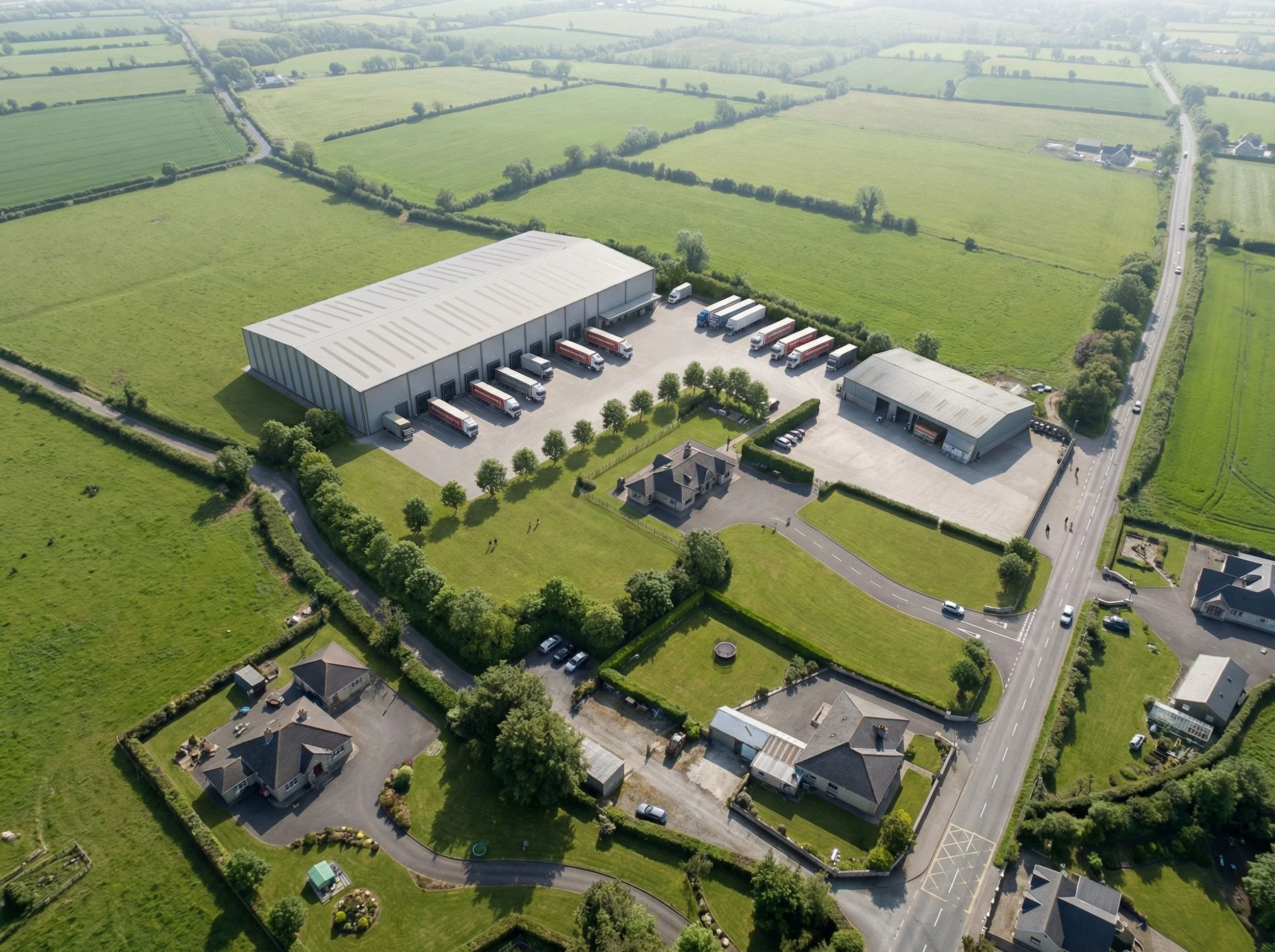
Set within an existing rural yard outside Navan, this proposal extends an established logistics and transport operation through the addition of a new warehouse and docking facility. Located within a dispersed agricultural landscape shaped by hedgerows, narrow roads and incremental patterns of development, the project seeks to work with the existing character of the site rather than overwrite it.
The site occupies a transitional condition between domestic, agricultural and light industrial use. Existing trailer parking, storage yards and service buildings already establish the operational nature of the place, while neighbouring one-off houses and open fields frame its edges. The proposal acknowledges this mixed condition directly, organising new development in a way that consolidates activity within the existing working yard and limits further spread across the surrounding landscape.
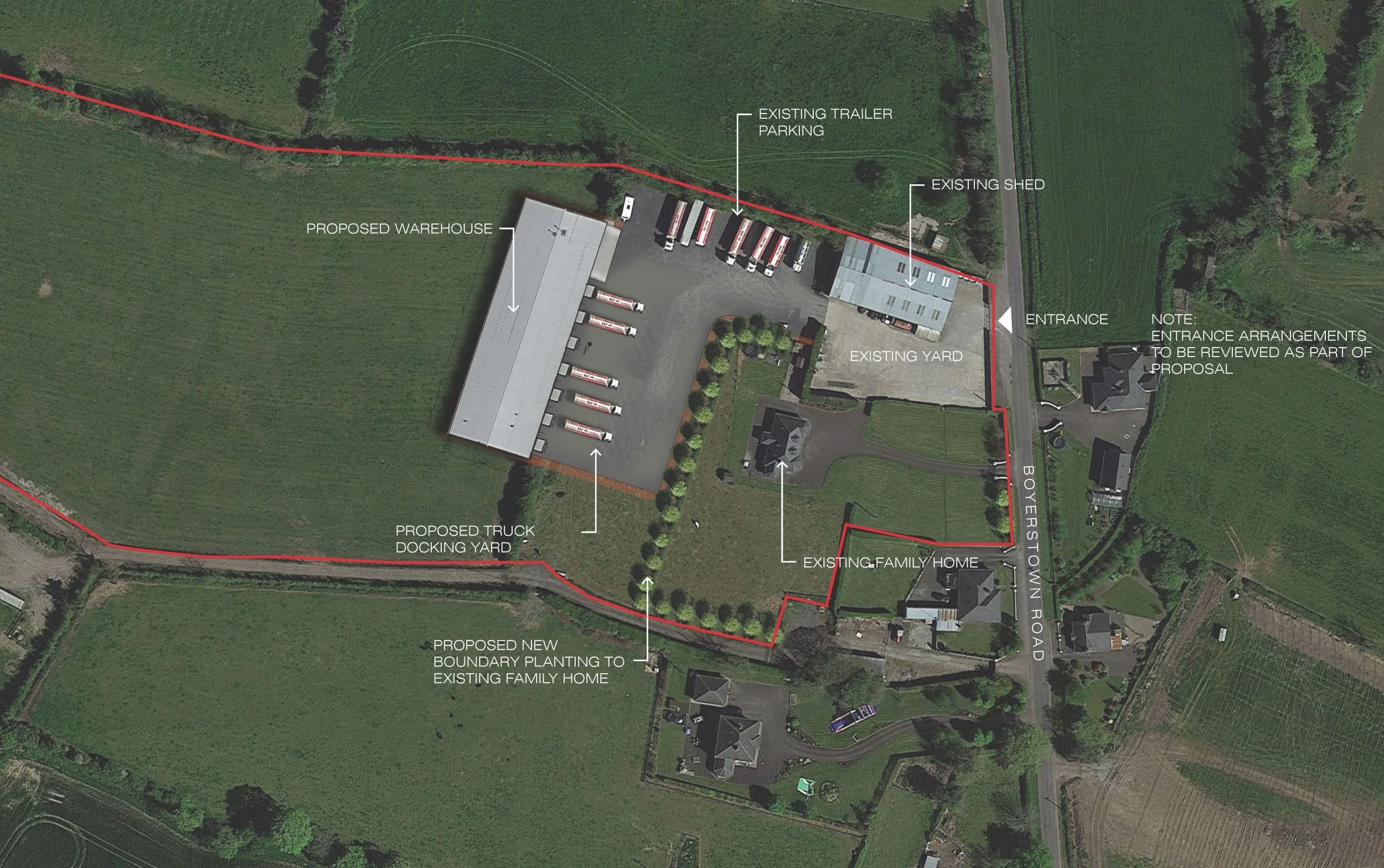
The placement of the warehouse emerges from the geometry of the site itself. Positioned alongside the existing yard infrastructure, the building forms a contained operational court for loading, circulation and servicing. This arrangement reduces fragmentation across the site and allows the retained open land and boundary hedgerows to continue to define the wider setting. The proposal relies on organisation and proximity rather than extensive new infrastructure or engineered landscape interventions.
Particular attention was given to the relationship between the operational areas and the existing family home located within the site boundary. New planting and the careful positioning of circulation routes establish a gradual transition between domestic and industrial uses, reinforcing separation through landscape rather than barriers alone. Service yards and docking areas are oriented inwardly, reducing direct visual impact while maintaining the functional clarity required for day-to-day logistics activity.
The building itself adopts a straightforward industrial form defined by a simple pitched roof and a regular structural rhythm. Its proportions are shaped primarily by operational requirements, yet the restraint of the form allows the warehouse to sit more quietly within the wider rural context. Repetition, span and enclosure become the architectural language of the project, avoiding unnecessary complexity while allowing the scale of the building to read clearly and coherently.
Internally, the warehouse is organised as a clear and adaptable volume structured around storage racks, marshalling areas and loading bays. The arrangement prioritises ease of movement and long-term flexibility, enabling the building to accommodate evolving operational needs over time. Dock levellers and servicing infrastructure are integrated directly into the overall form of the building, reinforcing the idea of the warehouse as a working piece of infrastructure rather than a standalone architectural object.
The proposal also considers the experience of arrival and movement across the site. Existing entrance arrangements are retained and reviewed as part of the wider development strategy, allowing the project to evolve incrementally from the operational patterns already established. Vehicular circulation, trailer storage and loading activities are organised to minimise conflict points while maintaining a legible sequence through the yard.
Rather than treating the rural setting as a backdrop, the project recognises the landscape as an active framework shaping how industrial activity can be accommodated outside urban centres. The development is conceived not as an isolated insertion, but as part of an evolving working landscape where agriculture, infrastructure, housing and logistics continue to coexist in close proximity. Through consolidation, careful siting and restrained form-making, the proposal aims to bring greater order and clarity to an already active site while maintaining the character of its rural surroundings.