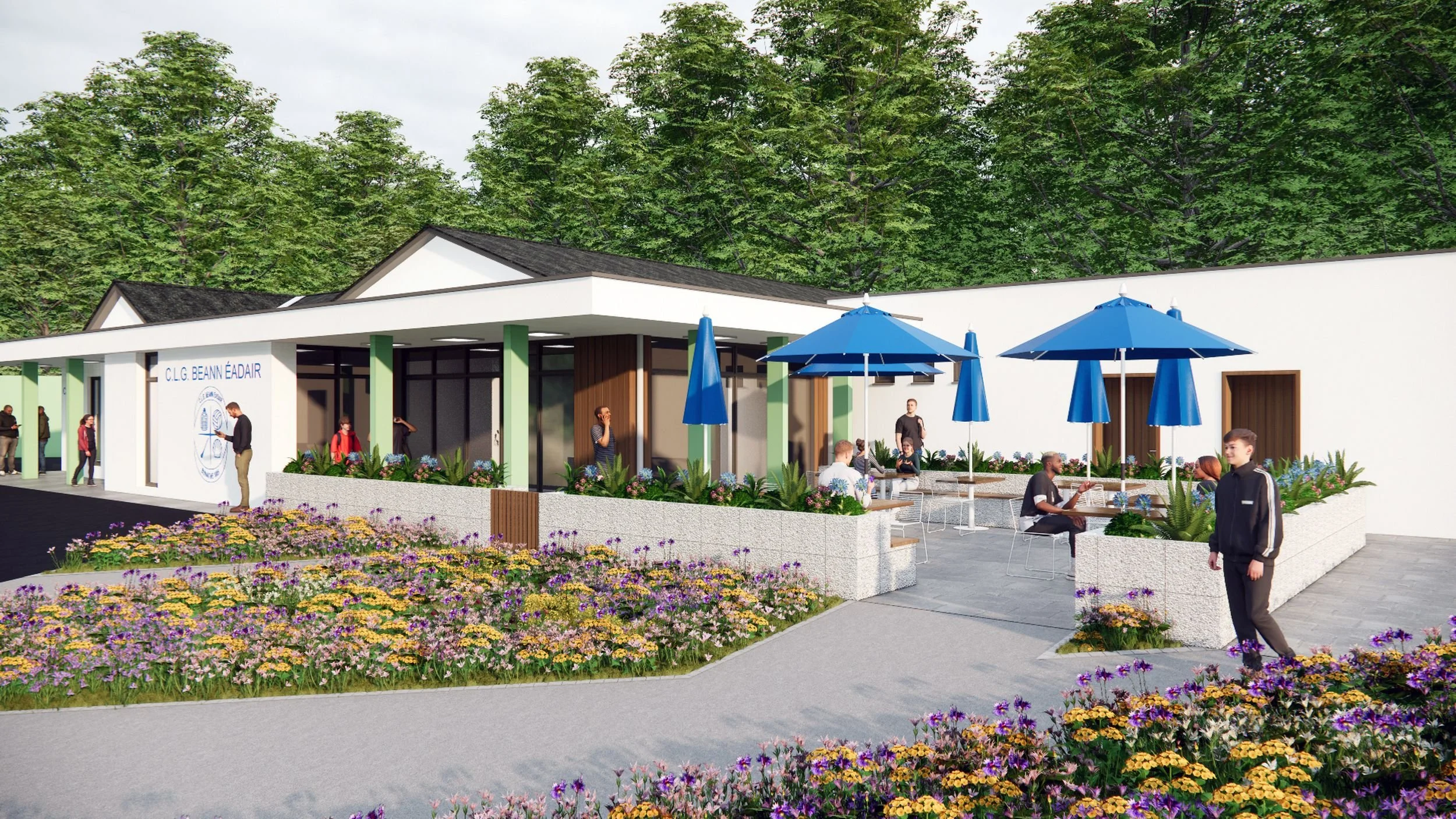
Beann Eadair GAA, Howth
Beann Eadair GAA, Howth
Clubhouse Extension, Hurling Wall & other works
Set high on Howth Head, the Beann Eadair clubhouse occupies a remarkable position overlooking the pitches, Ireland’s Eye, Lambay Island and the north Dublin coastline. The proposal began with an understanding that the value of the site extended beyond the building itself. The project sought to strengthen the relationship between sport, landscape and community while improving facilities for a growing and ambitious club.
The existing clubhouse had developed incrementally over time and lacked coherence in both plan and form. Internal circulation was fragmented, changing facilities were undersized, and the social spaces turned away from the site’s most significant views. The proposal reorganises the building as a clearer and more unified structure, balancing functional requirements with spaces for gathering, viewing and informal use throughout the year.
A new extension to the west accommodates modern changing facilities arranged around a protected circulation spine, while the existing changing rooms are repurposed as a gym and training space. The intervention increases capacity without overwhelming the scale of the existing clubhouse. Ancillary functions are consolidated and rationalised to allow the social areas of the club to open more directly towards the pitches and sea beyond.
The social heart of the building is reoriented north and west towards the landscape. Large areas of glazing frame long views across the playing fields while a sheltered external colonnade and patio create a protected edge between building and pitch. A deep roof overhang extends the use of the clubhouse outdoors, allowing spectators and members to occupy the threshold space in changing weather conditions typical of the exposed coastal site.
The project also introduces a new hurling wall enclosure, additional changing facilities and secure storage areas positioned carefully within the wider grounds. These elements are integrated into the topography of the site rather than treated as isolated additions. Retaining walls, embankments and planted edges help mediate level changes while maintaining the open character of the landscape.
Materially, the proposal adopts a restrained palette intended to unify old and new work into a single civic presence within the grounds. The emphasis is placed less on object-making and more on creating a robust and welcoming framework for everyday club life — training, gathering, spectating and community use across generations.